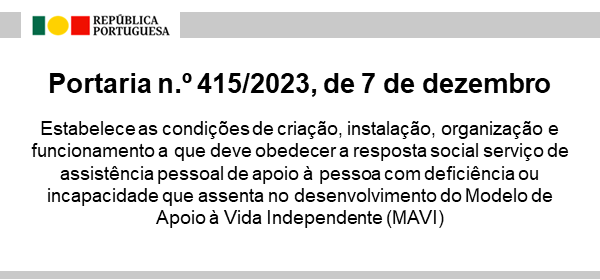
Ministerial Implementing Order No 415/2023 of 7 December 2023
12/12/2023
The Programme of the XXIII Constitutional Government established as one of the priorities of government action the promotion of the inclusion of people with disabilities as an imperative of a cohesive society and that aims to realize its full potential.
In the development of policies for the inclusion of persons with disabilities, the Government recognizes as fundamental the guarantee of conditions of access and exercise of citizenship rights through their participation in the various contexts of life on an equal basis with other citizens and with the maximum possible autonomy and self-determination.
In the development of this constitutional imperative, a Law 38/2004 of 18 August, which approved the bases of the legal framework for the prevention, empowerment, rehabilitation and participation of persons with disabilities, set as main objectives in this area the promotion of equal opportunities, the promotion of lifelong education, work and training opportunities, the promotion of access to support services and the promotion of a society for all, through the removal of barriers and the adoption of measures aimed at the full participation of persons with disabilities.
At international level, with the ratification of the United Nations Convention on the Rights of Persons with Disabilities in July 2009, the Portuguese Republic committed itself to promoting, protecting and guaranteeing decent living conditions for persons with disabilities and taking responsibility for taking the necessary measures to ensure the full recognition and exercise of their rights, within a framework of equal opportunities.
The right to personal assistance is defined in Article 19(b) of the Convention, which stipulates that persons with disabilities have access to a variety of home, residential and other community support services, including personal assistance necessary to support life and inclusion in the community and to prevent isolation or segregation from the community.
The Government has also committed to work towards the implementation of the European Commission’s Strategy for the Promotion of the Rights of Persons with Disabilities 2021-2030 and the Council of Europe’s Disability Strategy 2017-2023. Confirming this desire, the National Strategy for the Inclusion of Persons with Disabilities 2021-2025 determines, as one of its measures, the approval of the definitive model of support for independent living.
Indeed, in 2017, and with a view to pursuing this aim, the XXI Constitutional Government established the Support Model for Independent Living - Personal Assistance, through the Decree-Law No 129/2017, of 9 October, as amended.
Drawing on the experience of the pilot projects and with the involvement and participation of people with disabilities, their families and representative organisations, and developing the regime established in Law No. 38/2004, of 18 August, the XXIII Constitutional Government proposes to create the Model of Support for Independent Living (MAVI), integrated and innovative in the Portuguese system of social protection and promotion of non-institutionalization.
In this context, this Order implements the MAVI, laying down the rules for the creation, organisation, management and operation of independent life support centres (CAVIs), the exercise of the activity of personal assistance, defining the recipients covered and the conditions of eligibility, as well as funding.
Considering the mission of the National Institute for Rehabilitation, I.P., to ensure the planning, implementation and coordination of national policies aimed at promoting the rights of persons with disabilities and/or disabilities and the tasks associated with them, the operationalisation of MAVI, even as a social response, can only count on the intervention, particularly in the technical dimension, of this institute, without prejudice to the specific role that the Social Security Institute, I.P., has in this context.
Source: Diário da República No 236/2023, Series I of 2023-12-07
